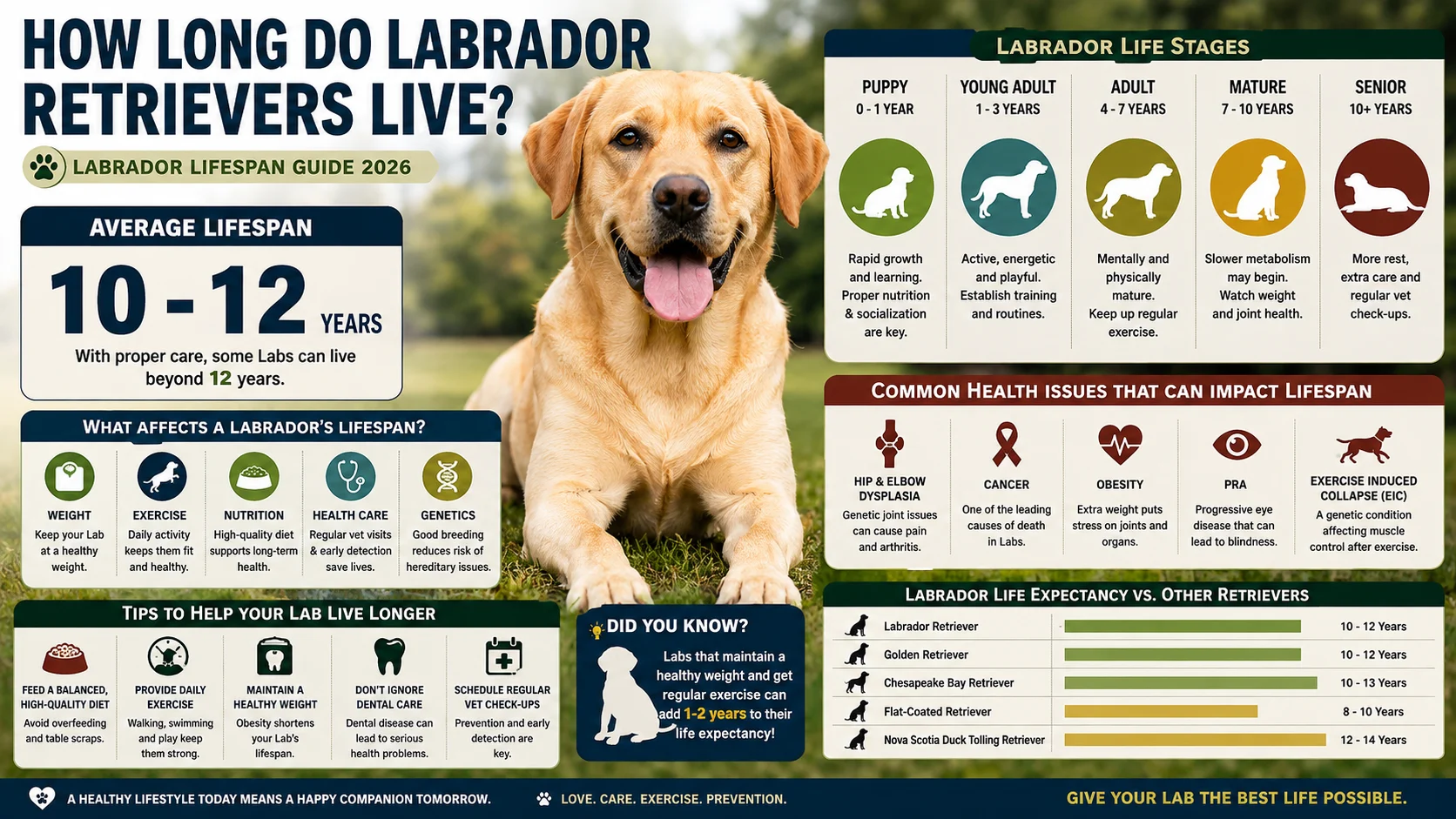
Most Labrador Retrievers live about 10 to 12 years, although genetics, weight, nutrition, exercise, and preventive veterinary care can make a meaningful difference.
The biggest lifespan mistake owners make is focusing on age alone instead of protecting their Lab from obesity, joint disease, and preventable health problems throughout life.
Quick Snapshot
| Labrador Lifespan Factor | Key Information |
|---|---|
| Average Labrador lifespan | About 10 to 12 years |
| Common life expectancy | Around 10 to 12 years |
| Some Labs | May live beyond 12 years |
| Puppy stage | Birth to about 1 year |
| Young adult | About 1 to 3 years |
| Mature adult | About 4 to 7 years |
| Senior stage | Around 7 to 8+ years |
| Major lifespan concerns | Obesity, cancer, joint disease |
| Important prevention | Healthy weight, exercise, veterinary care |
| Most important factor | Overall health and genetics |
What Is the Average Labrador Lifespan?
The typical Labrador Retriever lifespan is around 10 to 12 years.
That number is an average, not a deadline.
Some Labradors develop serious age related disease earlier, while others remain active well into their senior years. Genetics, body condition, breeding quality, nutrition, activity level, and veterinary care all influence how a Lab ages.
The important distinction is between living longer and living well.
A healthy 11 year old Labrador that still enjoys walks, food puzzles, family interaction, and comfortable movement is a very different picture from a dog that reaches the same age with severe obesity and untreated joint disease.
How Long Do Labrador Retrievers Live?
Short Answer
Most Labrador Retrievers live approximately 10 to 12 years.
Can a Labrador Live 13 or 14 Years?
Yes, some Labs can reach 13 or 14 years, although that should not be treated as the expected lifespan for every dog.
Exceptional longevity is influenced by several factors rather than one “longevity gene.”
Important factors include:
• genetics and family history
• maintaining a healthy body weight
• regular physical activity
• dental care
• preventive veterinary examinations
• early detection of disease
• appropriate nutrition
• responsible breeding
Here is where many owners get it wrong: keeping a Labrador alive longer is not the only goal. Maintaining mobility, comfort, cognitive function, and enthusiasm for daily life matters just as much.
Labrador Life Expectancy by Life Stage
A Labrador changes considerably over its lifetime. Treating a seven year old Lab exactly like a two year old can create problems, particularly when exercise, calories, and recovery time are not adjusted.
| Life Stage | Approximate Age | What to Expect |
|---|---|---|
| Newborn puppy | 0 to 8 weeks | Rapid physical development |
| Puppy | 2 to 6 months | Socialization, teething, rapid growth |
| Adolescent | 6 to 18 months | High energy and behavioral development |
| Young adult | 1.5 to 3 years | Physical maturity and strong activity levels |
| Adult | 4 to 7 years | Stable temperament and athletic ability |
| Mature adult | 7 to 9 years | Early signs of aging may appear |
| Senior | 9 to 12+ years | Greater focus on mobility and preventive care |
These boundaries are approximate. Individual dogs age at different rates.
Labrador Puppy Development and Its Connection to Lifespan
Birth to 8 Weeks
The first weeks are dominated by:
• neurological development
• rapid growth
• coordination
• early social behavior
Responsible breeding begins influencing lifelong health before the puppy ever reaches its new home.
8 Weeks to 6 Months
This is a major learning period.
A Labrador puppy needs appropriate:
• socialization
• nutrition
• controlled exercise
• veterinary care
• bite inhibition training
One important point is often missed: more exercise is not automatically better for a growing Labrador.
Puppies need movement, but excessive repetitive impact can place unnecessary stress on developing joints.
6 to 18 Months
This is the adolescent period.
Your Lab may look almost adult while still behaving like a puppy.
Expect:
• high energy
• increased curiosity
• testing boundaries
• strong food motivation
• continued physical development
Keeping body weight under control becomes particularly important during this stage.
Labrador Lifespan and Body Weight
Why Obesity Matters So Much
Obesity is one of the most important preventable threats to a Labrador’s long term health.
Labs are famously food motivated, which can make overfeeding surprisingly easy.
Extra body weight places additional stress on:
• hips
• elbows
• knees
• spine
• cardiovascular system
It can also make an already active dog less willing to move.
The vicious cycle is simple:
extra weight → less movement → further weight gain → greater joint stress
Breaking that cycle early is much easier than trying to reverse severe obesity in an older Labrador.
What Should a Healthy Lab Look Like?
You should be able to:
• feel the ribs without pressing hard
• see a visible waist from above
• identify an abdominal tuck from the side
A Labrador does not need to look extremely lean. The goal is healthy body condition, not a competition physique.
Major Health Problems That Can Affect Labrador Lifespan
Hip and Elbow Dysplasia
Labradors are predisposed to orthopedic problems, including hip and elbow dysplasia.
These conditions can lead to:
• pain
• stiffness
• reduced activity
• arthritis
Responsible breeding and maintaining a healthy weight are important pieces of prevention and management.
Cancer
Cancer is an important health concern in older Labradors.
Possible warning signs include:
• unexplained lumps
• persistent weight loss
• unusual tiredness
• changes in appetite
• abnormal swelling
Not every lump is cancer, but a new or changing mass deserves veterinary evaluation.
Exercise Induced Collapse
Some Labradors carry a genetic mutation associated with exercise induced collapse.
Affected dogs can develop weakness or collapse after intense activity.
Genetic testing can help responsible breeders identify carriers and make informed breeding decisions.
Progressive Retinal Atrophy
Some inherited eye diseases can cause progressive vision loss.
This is another reason health screening and responsible breeding matter when evaluating a Labrador puppy.
Labrador Lifespan by Color
A common internet question is whether yellow, black, or chocolate Labradors live longer.
Does Labrador Color Affect Lifespan?
Coat color itself should not be treated as a simple predictor of lifespan.
However, research has reported differences in health outcomes between color groups in some Labrador populations, particularly concerning chocolate Labradors. This does not mean every chocolate Lab has a shorter life or that yellow and black Labs are automatically healthier.
The more useful question is:
How healthy is the individual dog’s breeding line?
Responsible breeders should be evaluated based on health screening, temperament, structure, and family history rather than coat color alone.
Can You Increase a Labrador’s Lifespan?
You cannot guarantee a specific lifespan.
You can, however, improve the odds of a healthier and more comfortable life.
1. Keep Your Lab at a Healthy Weight
This may be one of the highest impact things an owner can control.
Measure meals rather than estimating portions.
Treats count too.
2. Provide Regular Exercise
Labradors need consistent activity throughout life.
Good options include:
• walking
• swimming
• retrieving games
• controlled hiking
• scent games
As your Lab ages, intensity should gradually decrease when necessary while daily movement remains part of the routine.
3. Protect Joint Health
Avoid allowing puppies to become overweight.
For adults, maintaining muscle while controlling body fat can help preserve mobility.
Older Labs may benefit from:
• shorter walks
• softer surfaces
• ramps
• supportive bedding
• veterinarian guided joint management
4. Stay Current With Veterinary Care
Preventive examinations become increasingly valuable as dogs age.
Routine veterinary care can help detect problems before they become obvious at home.
5. Do Not Ignore Small Changes
Older Labradors often hide discomfort surprisingly well.
Pay attention to:
• slower rising
• reluctance to use stairs
• reduced appetite
• excessive drinking
• nighttime restlessness
• changes in interaction
• new lumps
A gradual change is still a change.
Senior Labrador Care
When Is a Labrador Considered a Senior?
There is no exact birthday when a Labrador suddenly becomes “old.”
Many Labs begin entering their senior years around 7 to 8 years, with more obvious aging often occurring later.
What Changes With Age?
You may notice:
• more sleeping
• slower recovery after exercise
• gray hairs around the muzzle
• reduced hearing
• changes in vision
• joint stiffness
These changes are common, but they should not automatically be dismissed as “just old age.”
Pain and disease are treatable in many cases.
How to Care for an Aging Labrador
Adjust Exercise Instead of Eliminating It
An older Lab still benefits from movement.
Instead of long strenuous sessions, consider:
• shorter walks
• gentle swimming
• sniffing walks
• low impact games
The objective is to preserve mobility without exhausting the dog.
Reassess Nutrition
Senior dogs may have different calorie and nutritional requirements.
Do not automatically switch food simply because your Labrador reaches a certain birthday. Discuss changes with your veterinarian based on body condition, activity, and health.
Pay Attention to Cognitive Changes
Some older dogs develop age related cognitive changes.
Potential signs include:
• confusion
• altered sleep patterns
• getting stuck in unusual places
• house training changes
• reduced interaction
Early veterinary discussion can help distinguish normal aging from medical problems.
What Breeders Can Tell You About Labrador Longevity
One of the most valuable pieces of information when buying a Labrador puppy is the health history of its relatives.
Ask About the Parents
A responsible breeder should be willing to discuss:
• hip evaluations
• elbow evaluations
• eye examinations
• relevant genetic testing
• family health history
• longevity of older relatives
Look Beyond the Parents
The grandparents and older relatives can sometimes provide useful clues about longevity and inherited disease.
Experienced breeders do not simply ask, “Are the parents healthy?”
They look at the broader family picture.
A puppy from parents that are both young and healthy tells you less about longevity than a breeding program with a well documented history of healthy older dogs.
Buyer Warning: Do Not Buy Based on Appearance Alone
A Labrador puppy with a beautiful coat and friendly face can still come from questionable breeding.
Red Flags
Be cautious when a breeder:
• cannot provide health documentation
• refuses to discuss genetic testing
• focuses heavily on unusual colors
• always has puppies available
• makes guaranteed lifespan claims
• dismisses orthopedic problems
• claims their line “never gets sick”
No ethical breeder can guarantee that a Labrador will live a specific number of years.
Genetics provide probabilities, not promises.
Common Mistakes That Can Shorten a Labrador’s Healthy Years
Overfeeding
Labs are experts at convincing people they are starving.
Those pleading eyes are not a nutritional assessment.
Too Little Exercise
A sedentary Labrador can gain weight quickly and lose muscle condition.
Too Much High Impact Exercise
More is not always better, especially for puppies and dogs with joint problems.
Ignoring Dental Health
Dental disease can become increasingly important as dogs age.
Waiting Until Something Looks Serious
Many diseases are easier to manage when identified early.
What Most Labrador Lifespan Articles Miss
Longevity Starts Before the Puppy Comes Home
Breeding decisions influence:
• orthopedic health
• inherited disease risk
• temperament
• genetic diversity
That makes breeder selection part of lifespan planning.
Body Condition May Matter More Than the Number on the Scale
Two Labradors can weigh the same but have completely different body compositions.
A scale alone cannot tell you whether your Lab is carrying excessive fat.
Senior Does Not Mean Inactive
One of the worst assumptions is that an older Labrador should simply sleep all day.
Appropriate exercise helps preserve:
• muscle
• mobility
• mental stimulation
• quality of life
The activity needs to change with age, not disappear.
Labrador Lifespan Preparation Checklist
For Labrador Puppies
□ Research the breeder
□ Review health testing
□ Ask about family longevity
□ Schedule veterinary care
□ Establish measured feeding
□ Begin appropriate socialization
□ Avoid excessive impact exercise
For Adult Labradors
□ Monitor body condition
□ Maintain daily exercise
□ Keep vaccinations and preventive care current
□ Monitor dental health
□ Watch for unusual lumps
□ Maintain regular veterinary examinations
For Senior Labradors
□ Reassess exercise intensity
□ Monitor mobility
□ Watch appetite and drinking changes
□ Check for cognitive changes
□ Discuss age appropriate veterinary screening
□ Make home surfaces easier to navigate if mobility declines
Labrador Lifespan vs Other Popular Retrievers
| Breed | Approximate Typical Lifespan |
|---|---|
| Labrador Retriever | 10–12 years |
| Golden Retriever | 10–12 years |
| Chesapeake Bay Retriever | 10–13 years |
| Flat Coated Retriever | Often around 8–10 years |
| Nova Scotia Duck Tolling Retriever | Around 12–14 years |
These figures are broad population estimates, not guarantees for individual dogs.
Frequently Asked Questions
How long do Labrador Retrievers live?
Most Labrador Retrievers live around 10 to 12 years, although some live longer depending on genetics, health, weight, and overall care.
What is the average Labrador lifespan?
The commonly cited Labrador lifespan is approximately 10 to 12 years.
Is 10 old for a Labrador?
Ten is considered senior for a Labrador, but it is not necessarily the end of a healthy life. Many dogs at this age can still enjoy several active years.
Is 12 old for a Labrador?
Twelve is an advanced age for a Labrador, but some healthy individuals live beyond 12.
Can Labradors live to 15?
It is possible, but 15 would be unusually old for a Labrador Retriever rather than a typical lifespan.
Do chocolate Labs have shorter lifespans?
Some research has found health and longevity differences associated with chocolate coat color in certain Labrador populations. However, coat color alone cannot predict an individual dog’s lifespan.
What is the biggest threat to Labrador lifespan?
There is no single answer for every dog, but obesity, inherited disease, cancer, orthopedic problems, and other age related conditions are important concerns.
How can I help my Labrador live longer?
Keep your Lab at a healthy body condition, provide appropriate exercise, choose responsible breeding, maintain preventive veterinary care, and investigate health changes early.
Conclusion
The typical Labrador Retriever life span is about 10 to 12 years, but the number on the calendar tells only part of the story.
A Labrador’s longevity is influenced by genetics before birth and by everyday decisions after adoption. Weight control, appropriate exercise, responsible breeding, preventive veterinary care, and early attention to health changes can all contribute to a longer and more comfortable life.
If there is one lesson worth remembering, it is this:
Do not wait for your Labrador to become a senior before you start thinking about longevity.
The healthiest senior Labs are usually built through years of small decisions made while they were still young.